
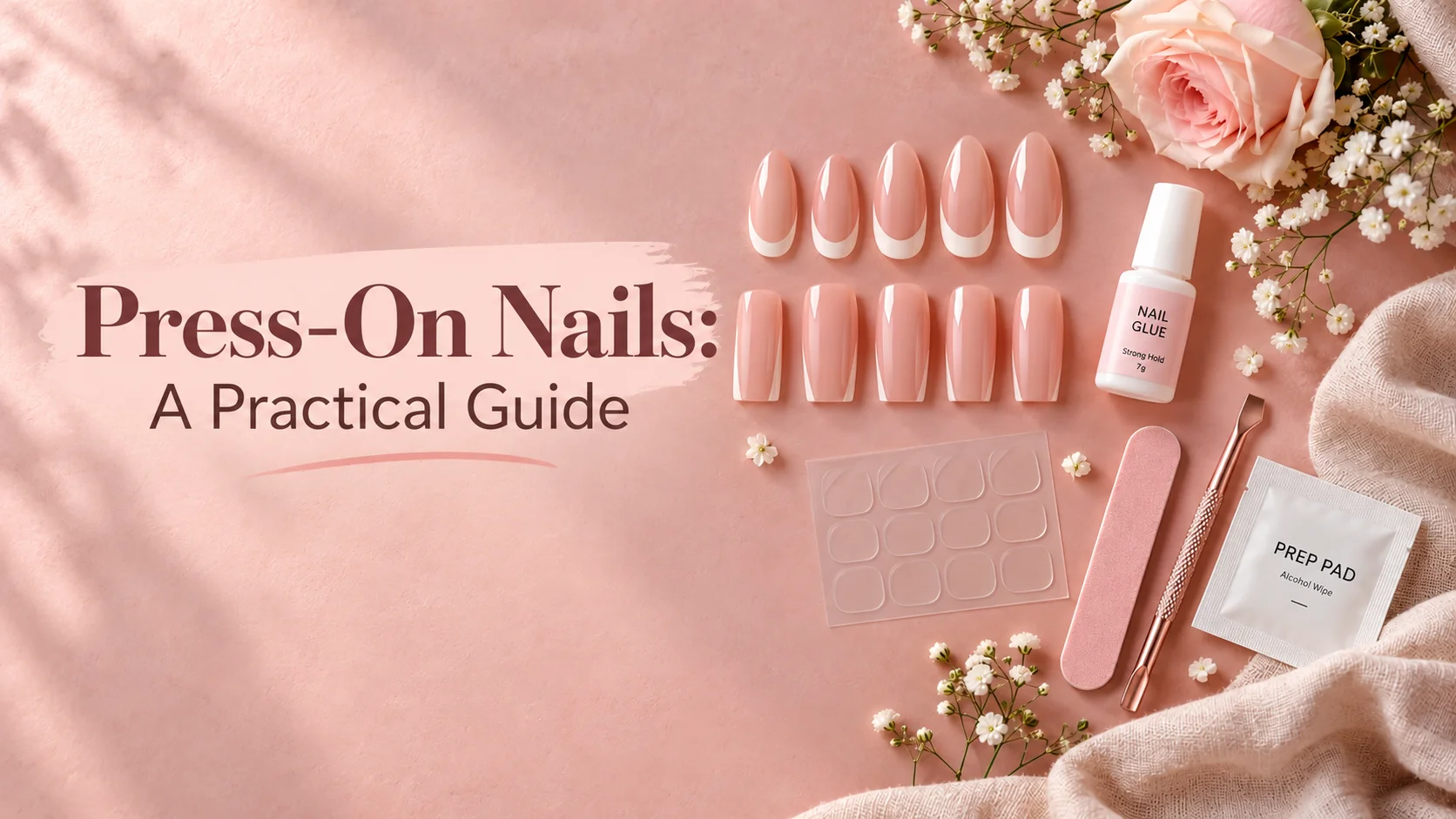
Press-On Nails: A Practical Guide for Beginners in India
Press-on nails are ready-made artificial nails that you stick onto your natural nails at home, using nail glue or adhesive tabs, in about 20 to 30 minutes. They suit anyone who wants a polished manicure without a salon appointment, and they can be removed without drilling or soaking in strong chemicals, as long as you remove them gently.
This guide explains how press-on nails work, the types available, how they compare with gel and acrylic nails, how to choose a set that fits, and how to apply, wear and remove them without harming your nails.
What Are Press-On Nails?
Press-on nails are pre-shaped nail extensions, usually made of ABS plastic or similar materials. They come in a kit of different sizes so you can match one to each finger. Unlike nail polish, there is no drying time. Unlike gel or acrylic, there is no lamp, no filing of your natural nail and no appointment.
Most sets include 24 or more nails in several sizes. Some include glue, adhesive tabs, a mini file and a prep pad. Check the listing before buying, as inclusions vary by brand.
How Do Press-On Nails Work?
The nail sticks to your natural nail through an adhesive layer:
- Nail glue forms a strong bond and generally lasts longer.
- Adhesive tabs are double-sided stickers. They are easier to remove and better for short-term wear, but usually hold for a shorter time.
The bond depends mostly on preparation and fit. A well-fitted nail on clean, oil-free nail surface holds far better than a perfect design on a poorly prepared nail.
Types of Press-On Nails
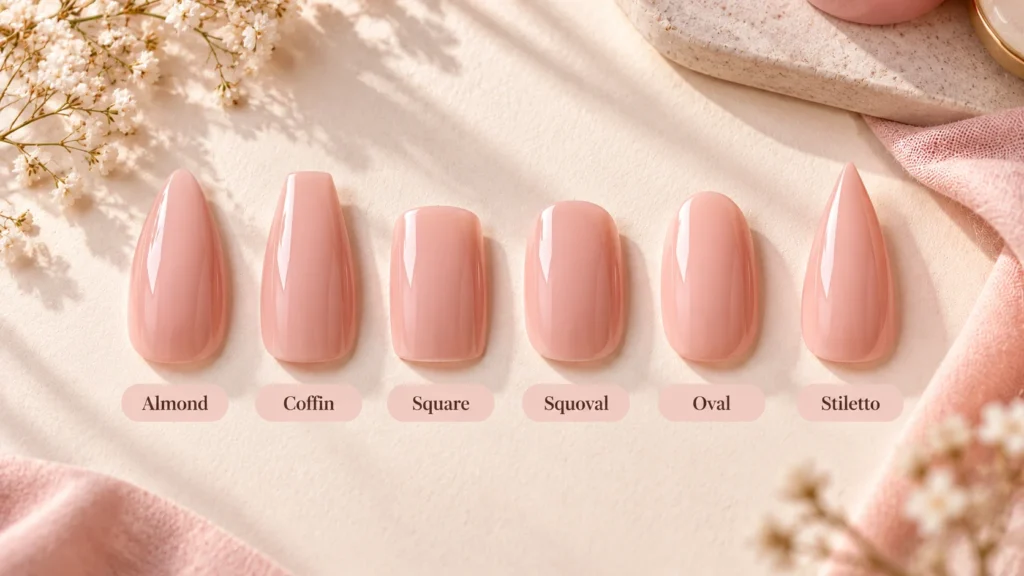
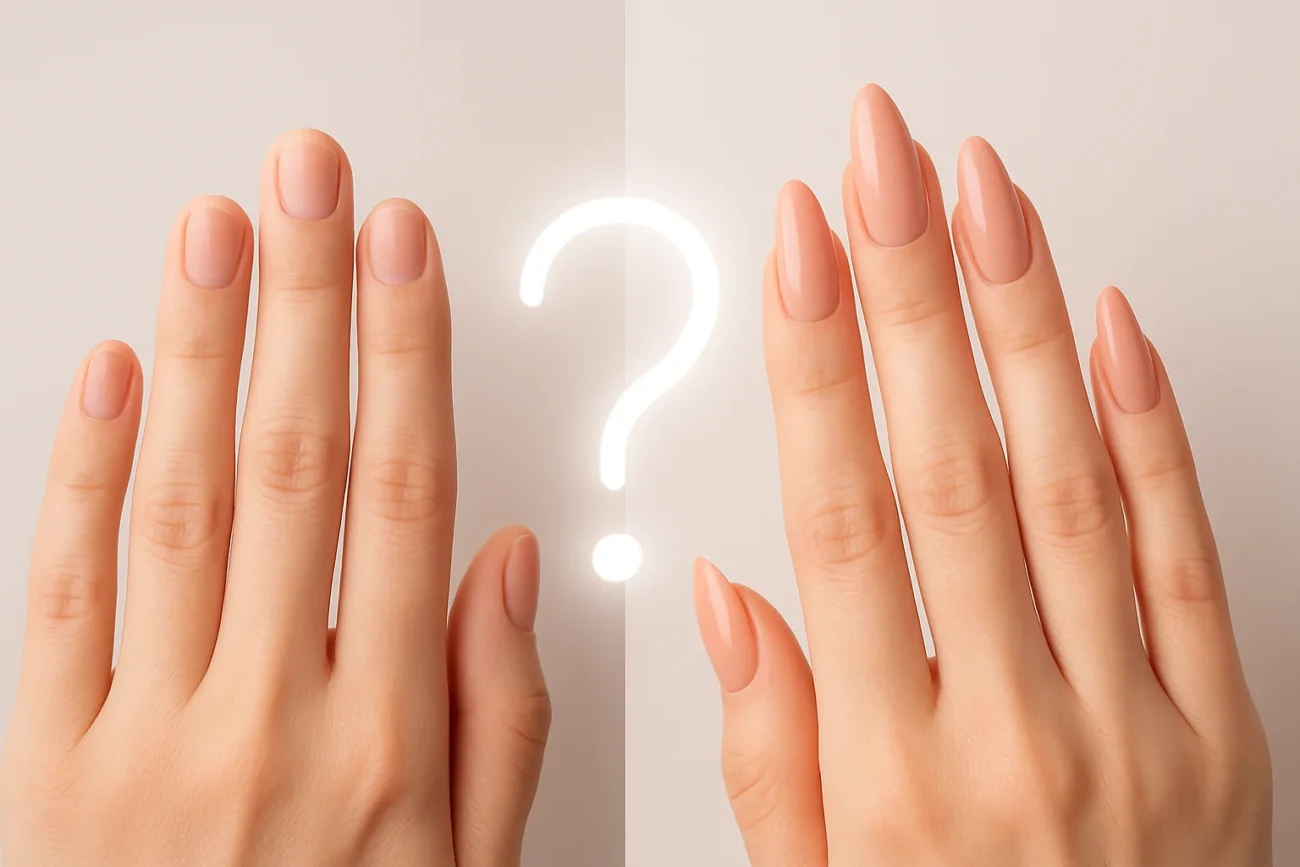
By shape: almond, coffin, square, squoval, oval, stiletto. Shorter lengths are more practical if you type a lot, cook or do housework.
By length: short, medium and long. Beginners usually find short to medium easiest to manage.
By finish: glossy, matte, chrome, glitter, French tip, 3D embellishments and hand-painted designs.
By coverage: full-cover nails cover the whole nail. Tips (nail tips) cover only part of it and need to be blended.
By make: factory-made sets and handmade or custom-made sets. Handmade sets often offer more unique designs and a more tailored fit, but check the seller’s sizing guidance.
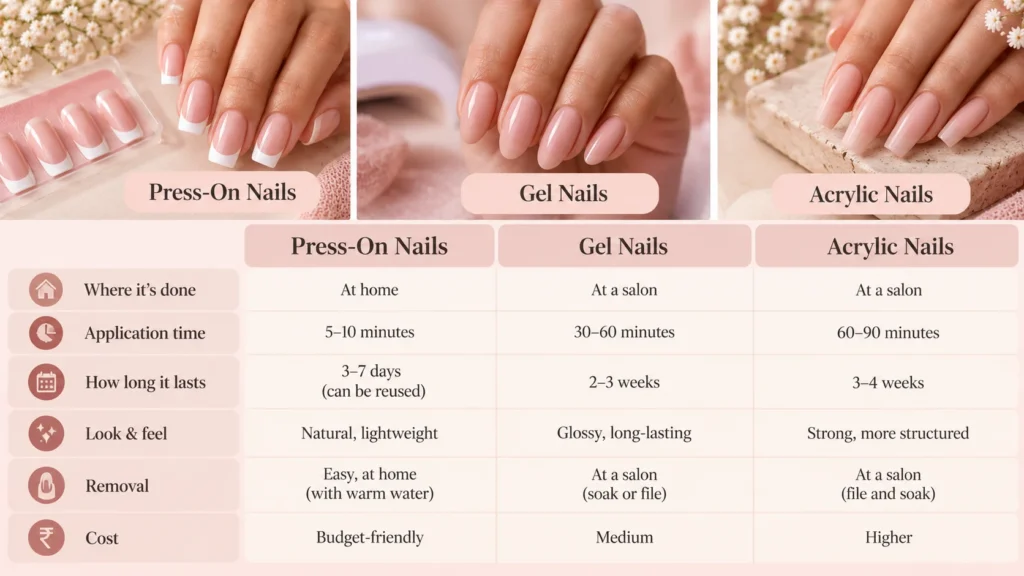
Press-On Nails vs Gel and Acrylic Nails
| Press-on nails | Gel nails | Acrylic nails | |
|---|---|---|---|
| Where done | At home | Salon (or home with a lamp) | Salon |
| Time to apply | Roughly 20–30 minutes | Longer, appointment needed | Longer, appointment needed |
| Wear time | Varies: days to about two weeks | Often around two to three weeks | Often around three weeks, with fills |
| Removal | Soak and gently lift | Soak-off or filing | Usually soak-off or filing |
| Natural nail prep | Light buffing | Buffing, often more | Buffing, more filing |
| Reusability | Possible with care | No | No |
Wear times are typical ranges that depend on your nails, lifestyle and technique. They aren’t guarantees.
The practical difference is commitment. Press-ons let you change your look often, try a length you’re unsure about, and avoid repeated salon visits. Gel and acrylic generally last longer and sit more seamlessly on the nail, which some people prefer for long-term wear.
Advantages and Disadvantages
Advantages
- Quick to apply and no drying time
- Wide choice of designs without nail art skills
- Can be reused with proper care
- Lower upfront commitment than a salon enhancement
- Easy to remove at home when done gently
Disadvantages
- Wrong sizing leads to lifting, gaps or discomfort
- Wear time can be shorter than salon nails, especially with tabs
- Glue can irritate skin in some people
- Poor removal (peeling) can damage the natural nail
- Very long or heavy designs can feel awkward at first
How to Choose the Right Press-On Nails
- Pick a length you can live with. If it’s your first set, go shorter than you think.
- Check the sizing. A nail should fit from sidewall to sidewall without overlapping your skin. If you’re between sizes, choose the slightly larger one and file the sides.
- Look for a kit that includes the basics: several sizes, prep pad, file, and either glue or tabs.
- Decide glue or tabs (see below).
- Read the seller’s guidance. Reputable sellers explain sizing, prep, wear time and removal clearly.
- Match design to lifestyle. Heavy 3D embellishments can catch on hair and clothes.
If you have very curved, very flat, wide or narrow nails, check whether the seller offers custom sizing.
Glue or Adhesive Tabs: Which Should You Use?
Choose glue for events, holidays or when you want maximum hold. Choose tabs when you want a one- or two-day look, or when you’re wary of glue on your skin. Some people use tabs on the first try, then move to glue once they’re confident with sizing.
Safety note: nail glue is a cyanoacrylate adhesive. It bonds skin quickly, so keep it away from your eyes and from children. Don’t confuse nail glue with eye drops or other small bottles. If you feel itching, swelling or burning after use, stop using it and consult a doctor. Allergic reactions to nail adhesives can occur.
How to Apply Press-On Nails
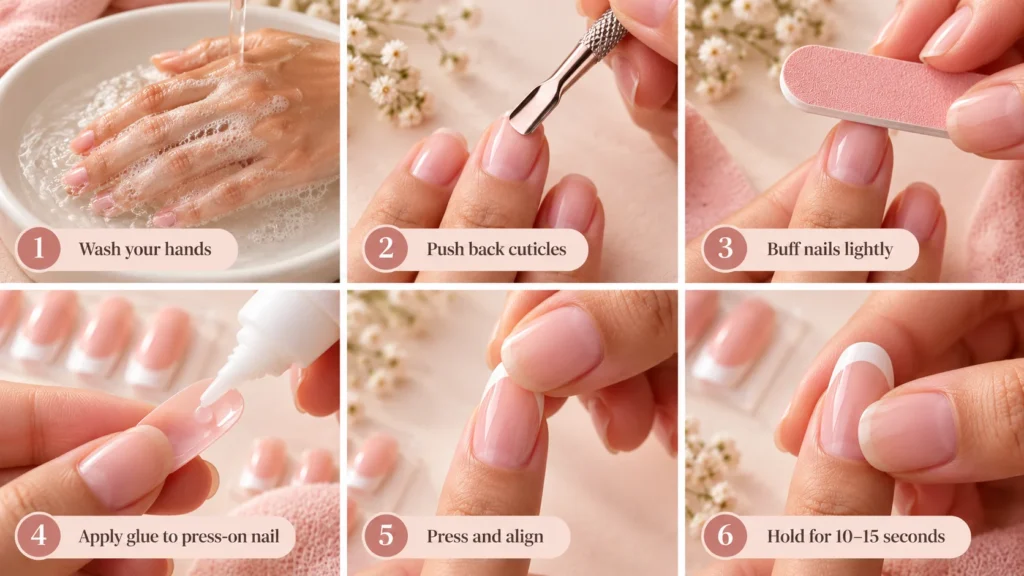
- Wash and dry your hands.
- Push back your cuticles gently with a cuticle pusher.
- Lightly buff the nail surface to remove shine, then wipe with the prep pad or alcohol to remove oil.
- Sort your nails by size and lay them out in order before you start.
- Apply a thin layer of glue to your natural nail (and a small amount to the press-on if the instructions suggest it). For tabs, stick the tab to the press-on nail first.
- Place the nail at the cuticle edge at a slight angle, then press it down flat.
- Hold firmly for 15–30 seconds, pressing from the centre outward.
- Avoid water for at least an hour if you used glue.
Work one nail at a time. If glue gets on skin, don’t pull. Wipe or soak gently.
For a full walkthrough with troubleshooting, see our detailed application guide (future internal link).
How Long Do Press-On Nails Last?
There’s no single answer. Your nail shape, how well you prepared, the adhesive and what your hands do all matter. A common range is several days with tabs and up to around two weeks with glue, though results vary by person.
In India, humidity, frequent handwashing, cooking, dishwashing and hot weather can all shorten wear time. To help them last:
- Prep carefully and don’t skip the oil-removal step.
- Wear gloves for washing up and cleaning.
- Avoid using your nails as tools to open cans or scrape surfaces.
- Keep hands moisturised, but avoid greasy creams right after application.
Are Press-On Nails Bad for Your Natural Nails?
Press-ons themselves aren’t inherently harmful. Most damage comes from how they’re applied and removed. Peeling or yanking them off can strip layers of the nail plate, which leaves nails thin, weak or sore. Aggressive buffing and leaving glue on for too long can also cause problems.
To reduce the risk:
- Buff lightly, not aggressively.
- Never rip a nail off.
- Give your nails a break between sets if they feel thin or sensitive.
- Stop and see a doctor or dermatologist if you notice persistent pain, discolouration, swelling or signs of infection.
How to Remove Press-On Nails Safely
- Trim or file the nail shorter if it’s long.
- Soak your fingertips in warm, soapy water for 10–15 minutes.
- Gently work a cuticle stick or orangewood stick under the edge. If it doesn’t lift, soak again.
- Remove gently, never forcibly.
- For stubborn glue, use a nail-safe glue remover as directed on the label.
- Wash your hands and apply cuticle oil.
If you plan to reuse a set, remove any glue residue carefully and store the nails in a clean, dry box.
Can You Reuse Press-On Nails?
Often yes, if they were removed gently and the glue residue is cleaned off. Sets applied with tabs are generally easier to reuse than those applied with glue. Handmade or heavily embellished sets can be more fragile, so check the seller’s advice.
Common Mistakes to Avoid
- Skipping nail prep
- Choosing a size that’s too small, which creates tension and lifting
- Using too much glue, which oozes onto the skin
- Not pressing long enough
- Getting nails wet too soon
- Using nails as tools
- Peeling them off
Are Press-On Nails Worth It?
Press-ons are a good choice if you want flexibility, speed and lower commitment. They’re less ideal if you need very long wear, have a nail or skin condition affecting your hands, or have had reactions to adhesives. If you’re unsure, start with a short, simple set and tabs so you can learn sizing and application before moving to glue.
Next steps: pick a shape and length, measure your nails against the size guide, and follow the application steps above. Then explore designs in our press-on nails collection (link to be verified).
9. FAQ
1. Are press-on nails good for beginners?
Yes. They need no tools beyond what’s usually in the kit. Start with a short length and tabs, and take your time with sizing.
2. How long do press-on nails last?
It varies. Tabs often last a few days, while glue may last up to around two weeks. Prep, fit and daily activities all affect this.
3. Do press-on nails damage your nails?
They shouldn’t when applied and removed gently. Damage usually comes from peeling them off, aggressive buffing or leaving them on too long.
4. Can I wear press-on nails with nail polish or gel on my natural nails?
You can apply them over polish, but a bare, buffed, oil-free nail gives the best grip. Glossy or oily surfaces reduce hold.
5. Can I shower or wash dishes with press-on nails?
Yes, after the glue has set (at least an hour is a common guideline). Prolonged water exposure and hot water can loosen the bond, so wear gloves for chores.
6. What size press-on nails should I buy?
Pick the size that covers your nail from sidewall to sidewall without touching the skin. If you’re between sizes, go slightly larger and file the edges.
7. Can I cut or file press-on nails?
Yes. Most can be shortened and reshaped with a nail file. Avoid cutting heavily embellished nails.
8. Are press-on nails safe if I’m allergic to nail products?
Not necessarily. Adhesives can cause reactions in some people. If you’ve had reactions before, patch-test first or ask a doctor.


Pingback: Press-On Nail Designs: 25+ Ideas, Colours & Styles to Try